

Introduction to 1,3-Propenesultone
1,3-Propenesultone (PST) is an unsaturated cyclic sulfonate ester with the molecular formula C₃H₆O₃S and a molecular weight of 120.13. It has a melting point of 83-84 °C and a boiling point of 118 °C at 0.1 mmHg. First reported in the late 1950s, PST contains both a carbon–carbon double bond and a sulfonate ring, which endow it with a higher reduction potential than 1,3-propanesultone (1,3-PS). This allows PST to decompose preferentially on the electrode surface and form a stable Solid Electrolyte Interphase (SEI).[1] In 2002, Hibara and co-workers at Mitsui Chemicals first proposed PST as an Electrolyte Additive for lithium-ion batteries.[2] Because of its structural similarity to 1,3-PS and a comparable decomposition mechanism, PST is regarded as an alternative to 1,3-PS.
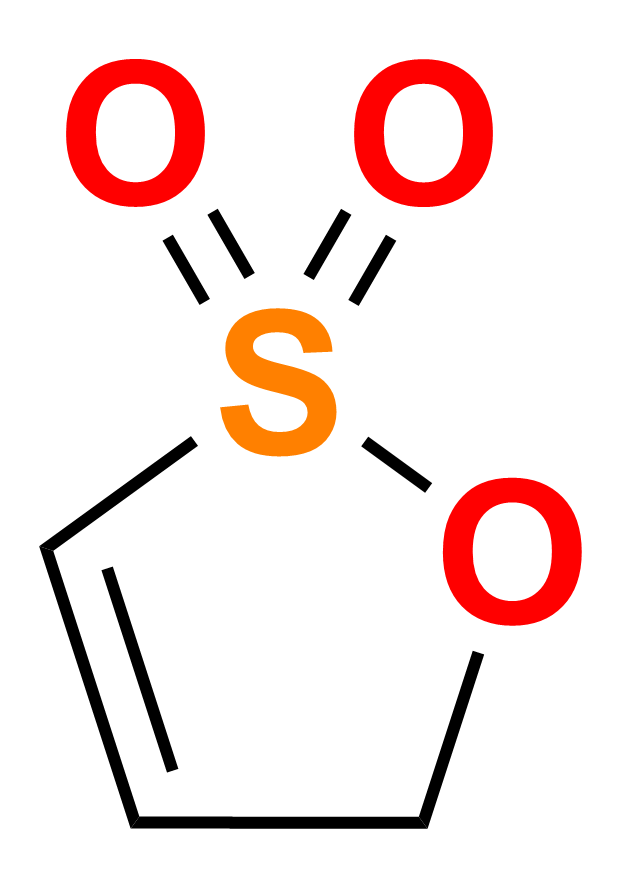
The application of 1,3-Propenesultone in lithium-ion batteries
As a key Electrolyte Additive, 1,3-Propenesultone (PST) markedly enhances the overall electrochemical performance of lithium-ion batteries. The underlying mechanism lies in its ability to undergo preferential redox reactions on both the cathode and anode surfaces, thereby forming a stable and uniform Solid Electrolyte Interphase (SEI). The specific improvements are manifested in the following three aspects.
1. Suppresses gas generation and enhance high-temperature performance
K. J. Nelson and co-workers investigated the effect of PST in NCM111/graphite cell and found that batteries containing 2 % PST generated significantly less gas during high-temperature storage and cycling than the 2 % VC control group. PST is used as a High Temperature Battery Additive. PST can improve the storage stability at 60 °C, suppresse voltage decay, and restrain impedance growth during storage.[3]
2. Enhance cathode stability
Bin Li et al.[4] demonstrated that 1,3-Propenesultone (PST) improves the stability of LiMn₂O₄ cathodes. During charge–discharge cycling, the presence of Mn³⁺ triggers the Jahn–Teller effect, destabilizing the structure, fracturing particles, and promoting severe Mn3+ dissolution, all of which degrade cycle life. Cells containing 5 % PST form a robust cathode-electrolyte interphase that suppresses Mn³⁺ leaching, thereby enhancing cathode stability and markedly improving cycling performance.
3. Compatible with high-capacity cathodes and High Voltage Lithium Batteries
Lithium-rich oxide is one of the most promising cathodes that meet high energy density requirement for batteries of the future, but its phase transformation from layer to spinel structure caused by the lattice instability presents severe challenge to cycling stability and the actually accessible capacity. In a high-voltage Li-rich Mn-based system, Wenqiang Tu et al. found that 2 % PST enhances the stability of the Li-rich cathode, increases the initial discharge capacity, and markedly improves the cycling performance of lithium-ion batteries.[5]
Other fields
1,3-Propenesultone (PST) incorporates a carbon–carbon double bond, a five-membered ring, and a sulfonyl group within a single molecule. The high ring strain of the five-membered cycle and the strong electron-withdrawing effect of the sulfonyl moiety jointly endow PST with exceptional reactivity, making it a valuable intermediate in both agrochemical and pharmaceutical syntheses.[6]
References
[1] Bo Tong, Ziyu Song, Huihai Wan, et al. Sulfur-containing compounds as electrolyte additives for lithium-ion batteries[J]. InfoMat., 2021, 3, 1-29.
[2] Hibara A, Ishida T. Non-aqueous electrolyte, secondary battery using the electrolyte, and additive for electrolyte[P]. JP2002329528A, 2002.
[3] K. J. Nelson, Jian Xia, J. R. Dahn. Studies of the effect of varying prop-1-ene-1,3-sultone content in lithium ion pouch cells[J]. J. Electrochem. Soc., 2014, 161, A1884-A1889.
[4] Bin Li, Yaqiong Wang, Haibo Rong, et al. A novel electrolyte with the ability to form a solid electrolyte interface on the anode and cathode of a LiMn2O4/graphite battery[J]. J. Mater. Chem. A, 2013, 1, 12954-12961.
[5] Wenqiang Tu, Yucheng Wen, Changchun Ye, et al. Phase transformation of lithium-rich oxide cathode in full cell and its suppression by solid electrolyte interphase on graphite anode. Energy Environ. Mater. 2020, 3, 19-28.
[6] Yugui Jiang, Yeqin Weng, Chao Zhang. A method for preparing 1,3-propenesultone[P]. CN118146188, 2024.
Technical challenges and optimization strategies for PST
When PST is used as the sole Electrolyte Additive, it tends to form an excessively thick SEI layer on the anode, raising cell impedance.
Current mainstream countermeasures:
1. Precise dosage control ;
2. Co-use with Low Impedance Additives to build a thin yet robust hybrid interphase;
3. Functional molecular design or solvation-structure tuning to further reduce charge-transfer resistance.
PST of Cheerchem
Cheerchem is committed to continuous technical innovation and process optimization, and has successfully developed a premium-grade PST product with the following core advantages:
Ultra-high purity: consistently ≥ 99.5 %.
Reliable quality: advanced manufacturing and rigorous QC guarantee excellent batch-to-batch consistency and long-term stability.
Secure supply: large-scale capacity and a robust supply chain that has served the lithium-battery industry for years.
Superior service: in addition to top-tier product, we offer rapid response and full-spectrum technical support backed by deep application expertise.